

Sustainable Practices
Habitat, biodiversity and climate change are key factors in our ecologies and communities that not only effect wildlife and our atmosphere but also the resources that we sustain through sustainable practices. Developing projects that include habitat restoration, climate resilience, natural species retention and hydrological protection create a continuing development of our natural resources.

Habitat Restoration

Red Sided Garter Snake, British Columbia
Restoration of Kiskatinaw River Wildfire 2025
Region: Northeast Omineca
Objective: Stand Rehabilitation
Project: Restoration for biodiversity, habitat, stream sedimentation, and erosion decrease. Project to increase CO2 sequestration and increase vegetation layers. Area is known for tourism and recreational use.
Protected area. Conservation Lands Foster Lake
An area of Crown land that has been withdrawn from disposition under the Land Act to conserve and manage fish and wildlife habitat.
Proposed: Natural Resources Canada November 2025
Hydrological Protection

Alces Lake, British Columbia
Spring 2026 Restoration of Fort St John Wildfire
Region: Northeast
Objective: Stand Rehabilitation
Project: Restoration of Alces River 2025 Wildfire, G8497 through reforestation and watershed protection. Natural species for the project include species for the retention of stream bank to decrease sedimentation and increasing temperatures.
Watershed: Alces River is a tributary to the Peace River, a major river in British Columbia, and begins in the Rocky Mountains and is approximately 70 kilometers in length. The Alces River is confluent to the Peace River and is headwater to the Peace River Corridor Protected Area and Peace River Corridor Park. Alces River is a tributary to the Peace River a few kilometers southwest of the Clayhurst Ecological Reserve.
Protected Areas: The Peace River Corridor Protected Area is southeast of Fort St John on the Peace River. It is 18 kilometers downstream from the Clayhurst Ecological Reserve which is also on the Peace River. The Clayhurst Ecological Reserve was established to conserve aspen grove communities and grasslands on slopes on the Peace River.
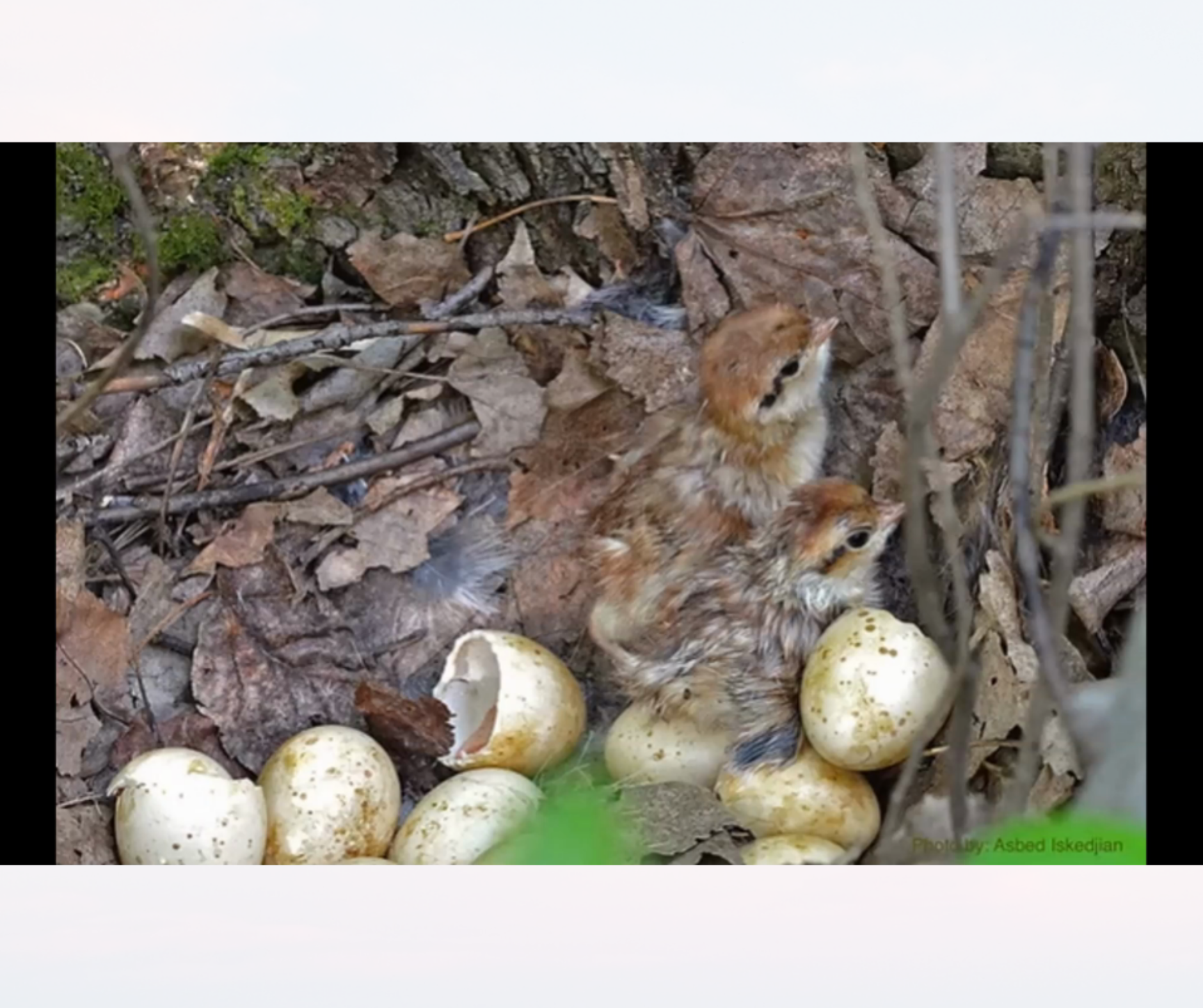
Spruce Grouse
(Falcipennis canadensis)
Grouse chicks and mother were found near the treeline on two separate forest areas near Prince George, British Columbia. Reporting Grouse and nesting sightings is an important aspect in Forestry that allows for the documentation of data and updates of mapping information systems as well as the protection of species in the future if necessary. The sites were followed up and there is as always a careful guard for nesting areas.
Distribution, Abundance, and Habitat
Both subspecies breed in British Columbia. F. c. canadensis occupies boreal forests in the north, while F.c. franklinii occupies montane forests in the southern two-thirds of the province (Campbell et al. 1990).
The Atlas confirms the Spruce Grouse to be a widespread breeder throughout much of British Columbia, east of the Coast Range Mountains. It may have been under-recorded by the Atlas due to its cryptic appearance and nature.
Atlas data show the highest Probability of Observation is in the Northern Boreal and Sub-Boreal Interior ecoprovinces, particularly east of Atlin Lake, and to a lesser extent the Skeena and Omineca Mountains. The Spruce Grouse occupies a wide altitudinal range, and is known to occur as high as 2,500 m (Campbell et al. 1990).
The Spruce Grouse nests on the ground in coniferous forests throughout its range, usually with a spruce component. This was borne out by Atlas Pobs modelling, which indicated highest values in the spruce-associated biogeoclimatic zones. (Campbell et al. 1990).
BC Breeding bird Atlas

Federal Sustainable Development Act
Act current to 2025-12-10 and last amended on 2020-12-01
S.C. 2008, c. 33
Assented to 2008-06-26
An Act to require the development and implementation of a Federal Sustainable Development Strategy and the development of goals and targets with respect to sustainable development in Canada, and to make consequential amendments to another Act
Her Majesty, by and with the advice and consent of the Senate and House of Commons of Canada, enacts as follows:
Short Title
1 This Act may be cited as the Federal Sustainable Development Act.
Interpretation
2 The following definitions apply in this Act.
appropriate Minister has the same meaning as in section 2 of the Financial Administration Act.
Commissioner means the Commissioner of the Environment and Sustainable Development appointed under subsection 15.1(1) of the Auditor General Act. (commissaire)
designated entity means an entity named in the schedule.
entity means
-
(a) any body named in any of Schedules I to II to the Financial Administration Act; or
-
(b) any Crown corporation as defined in section 2 of the Financial Administration Act.
Minister means the Minister of the Environment, unless the context otherwise requires.
precautionary principle[Repealed, 2019, c. 2, s. 1]
sustainability means the capacity of a thing, action, activity, or process to be maintained indefinitely.
sustainable development means development that meets the needs of the present without compromising the ability of future generations to meet their own needs.
target[Repealed, 2019, c. 2, s. 1]
- 2008, c. 33, s. 2
- 2019, c. 2, s. 1
Purpose
Marginal note: Purpose
3 The purpose of this Act is to provide the legal framework for developing and implementing a Federal Sustainable Development Strategy that makes decision making related to sustainable development more transparent and subject to accountability to Parliament, promotes coordinated action across the Government of Canada to advance sustainable development and respects Canada’s domestic and international obligations relating to sustainable development, with a view to improving the quality of life of Canadians.
- 2008, c. 33, s. 3
- 2019, c. 2, s. 2
Her Majesty
Marginal note: Application
4 This Act and the regulations are binding on Her Majesty in right of Canada.
Basic Principle
Marginal note: Principles
5 The following principles shall be considered in the development of sustainable development strategies:
-
(a) the principle that sustainable development is based on an efficient use of natural, social and economic resources and the need for the Government of Canada to integrate environmental, economic and social factors in the making of all of its decisions;
-
(a.1) the principle that sustainable development
-
(i) is a continually evolving concept,
-
(ii) may be achieved by, among other things, the protection of ecosystems, prevention of pollution, protection of human health, promotion of equity, conservation of cultural heritage, respect for domestic and international obligations relating to sustainable development and recognition of the present generation’s responsibility to provide future generations with a healthy and ecologically sound environment, and
-
(iii) may be advanced by, among other things, taking into account the precautionary principle, the “polluter pays” principle, the principle of internalization of costs and the principle of continuous improvement;
-
-
(b) the principle of intergenerational equity, which is the principle that it is important to meet the needs of the present generation without compromising the ability of future generations to meet their own needs;
-
(c) the principle of openness and transparency, which is the principle that the release of information should be encouraged to support accountability and public engagement;
-
(d) the principle that it is important to involve Aboriginal peoples because of their traditional knowledge and their unique understanding of, and connection to, Canada’s lands and waters;
-
(e) the principle of collaboration, which is the principle that it is important for stakeholders to collaborate in the pursuit of common objectives; and
-
(f) the principle that a results and delivery approach — that allows for developing objectives, developing strategies for meeting those objectives, using indicators for reporting on progress towards meeting those objectives and establishing accountability — is key to meeting measurable targets.
https://laws-lois.justice.gc.ca/eng/acts/f-8.6/page-1.html